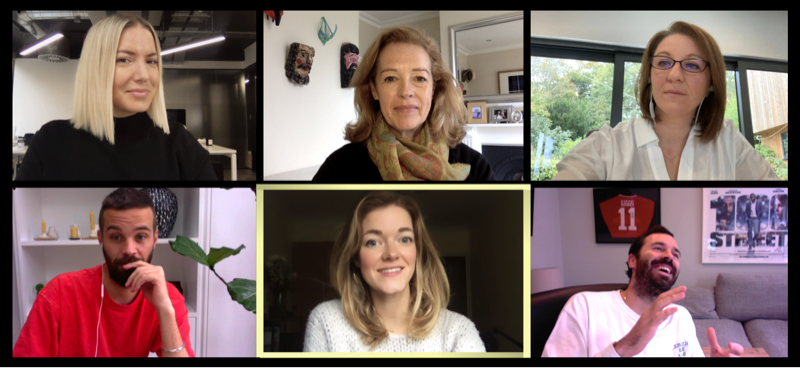
Branding is about feeling out the terrain, not planting a flag, according to Nikita Walia, who joins our Private View(s) podcast to talk about getting brand strategy out of the PDF and into the real world.
“I always loved learning about people,” says Nikita Walia – Partner, Strategy, at New York brand and venture studio U.N.N.A.M.E.D. That led her to study political science at NYU, intern at a social media agency (during the sector’s meteoric rise), and then spend time at branding and e-comm agencies before transitioning into life as a strategist.
Now heading up strategy at U.N.N.A.M.E.D., Nikita has partnered with Fortune 100s as well as early stage startups, using her grounding in cultural trends and semiotics to tackle foundational brand, business and innovation strategy. She also publishes Substack Thinking Out Loud.
For episode 28 of our Private View(s) podcast, we spoke about when brands need to hire strategists, and why excellent brand strategy should be flexible above all else.
Soundbites (lightly edited) from the episode below. Listen to the whole thing on SPOTIFY, SOUNDCLOUD and APPLE PODCASTS.
WHAT A SOCIAL MEDIA CAREER TEACHES ABOUT STRATEGY
“It’s being curious about people and the world. When you’re working in social – especially the speed that social media moves now – you take in so much information from so many different cultures, and people and even political movements happening around the world. It just naturally makes you attuned to filtering out what you don’t need to listen to, and what you can apply.”
STRATEGY ISN’T A SENTENCE IN A DECK
“There are half a dozen definitions floating around, and I think it’s controversial to say that I don’t think of strategy as a fixed object … the act of branding is less about planting a flag and more about map-making and feeling out a terrain. That’s similarly to how I see strategy, where it’s a tool for orientation. It gives you focus or meaning for a future you want to create, but it isn’t a singular sentence that lives in a deck.”
THE BEST BRAND STRATEGY FLEXES
“It’s something that needs to be specific enough to mean something, but flexible enough to mean many things to many people, in many departments. It needs to set an incentive for people at the highest level of the business that are making product decisions, and it also needs to make sense to the TikTok creator making TikToks for the brand everyday. And it’s quite hard to do that.”
IT’S A TOOL FOR ORIENTATION
“Something I like to set up early for clients is the understanding that this is going to be very much a tool for orientation for hopefully the next three to five years of the business. And for it to work – whether you’re a big or small org – you’re going to need to get everybody on board. Building that thing is the reason you all show up to work every day to get behind that goal. And that’s whether you’re a sneaker brand making sketches for shoes for the next season, or an engineer at a company making product decisions. Everybody needs to feel bought into that.”
YOU CAN’T REVERSE ENGINEER
“If you’re not aligned around it, ideologically and business-wise, it doesn’t make sense. It’s not research stapled to a deck. It’s not a shortcut to showing you did something, and it’s not a shortcut to justify a business decision you’ve made. You can’t reverse engineer the strategy to match a rebrand you’ve already chosen. It needs to be broad but also specific. And it needs to have life beyond a singular campaign.”
STRATEGY ISN'T STATIC
“How can we give clients tools to take the work forward and make it something useful for their creative teams, and easy to brief people in at the highest and lowest level? To us, that practically looks like Figma’s toolkits, instead of a traditional PDF or leather-bound book. It involves a lot of templating. And we’re experimenting with training AI on our work so clients can more effectively carry work forward. We’re trying to lean into the ambiguity and answer the moment.”
AGENCIES ARE GOING UPSTREAM
“I think both sides of the market are trying to crack the opposite problem. The management consultants are trying to be more creative. And the creative agencies are rightfully moving more upstream, trying to solve those thorny brand and business problems. I think that’s because we’ve all realised that often a brand problem is at its core a business problem. And I think having practitioners that can speak equally well to both is a secret weapon.”
SIGNS THAT YOU NEED A BRAND STRATEGIST
“Some of the signs are: the story keeps changing every six months, and you’re introducing yourself to the market in a different way. It can be subtle, but maybe the campaigns don’t feel like they’re coming from the same brand; there’s no creative through-line and your employees can’t really answer what you stand for as a company or where you’re trying to innovate. You aren’t seeing growth, even though you’re putting tons of dollars behind marketing. You’re entering a new terrain. Maybe you have a new product. Maybe you need to cultivate a new audience. You’re trying to enter a new geography and you don’t know the cultural customs. You’re reactive. You’re not directional.”
CONTROVERSIAL ADVICE FOR STRATEGISTS
“I tell young strategists to cultivate a hobby that doesn’t involve just scrolling, because you need to go out and see the world and talk to people. That can be taking a book and sitting at the bar and nursing one drink for a couple of hours ... You really have to go outside and be an interesting person outside of what we do. It’s so easy in this industry to make it all-consuming, and make that your singular purpose – but it doesn’t make your work very interesting.”